
Missouri City, TX · Garage Door Service
What the 1980s-90s Building Boom Left on Your Garage Door
Most Missouri City homes date to the 1980s-90s builder boom. Here's what that means for your garage door, your seals, and when it's worth fixing versus replacing.
- Repairs & new doors
- Springs & openers
- Serving 4 nearby communities
Doing Nothing For Now
If your door still goes up and down without grinding, you don't need to call anyone yet. A lot of homeowners in this area are sitting on doors that are twenty, even thirty years old, because the opener still works and the panel hasn't dented. That's a fine way to run a door until it isn't.
The honest limit here: once a steel skin has gone soft at the bottom corners or the seal has hardened into a stiff strip that cracks when you bend it, patching buys you a few months, not years. We don't push replacement on a door that's still sealing fine just because it's old. But we also won't tell you a 1990s single-layer door is worth re-sealing for the third time when the steel itself is the problem.
Most of the housing stock across this service area went up between 1976 and 2014, with the heaviest concentration in the 1980s and 90s. That means a huge share of doors out there are original equipment from a building wave that didn't spec insulation as standard. Knowing which decade your house falls into tells you more about your door than the brand name on it ever will.
How Local Conditions Play In
This area sits in a mild climate band with occasional freeze nights, not a hard-freeze climate. That matters for garage doors in a specific way: the steel isn't fighting repeated deep-freeze and thaw cycles that crack seams the way it would further north. So when a door fails here, it's rarely a cold-snap failure.
What it usually is instead is heat and humidity working on rubber and foam over a long season, plus UV on anything facing west or south. An uninsulated steel door built in the 1980s or 90s wasn't designed with a thermal break, so on hot afternoons that steel skin radiates heat straight into the garage, and over the years the bottom seal dries out faster than it would in a milder, drier climate.
The occasional freeze nights still matter at the margins. A seal that's already brittle from UV and heat exposure is the one that finally cracks on the one or two cold nights a year we actually get. It's not the freeze causing the problem. It's the freeze finding a weak point that summer already created.
The Problem
Houses on this side of the service area, in places like Quail Valley, Sienna Village, Fondren Gardens, and Braeburn, were mostly built during that 1976-2014 run, with the bulk going up in the 1980s and 90s. Builder-grade garage doors from that era, across Four Corners, Pecan Grove, and Cinco Ranch too, typically shipped as a single layer of rolled steel with no foam core behind it. Insulation wasn't a standard spec on entry-level doors back then the way it is now.
That single-layer construction is the actual problem, not age by itself. A thin steel panel with nothing behind it flexes more under wind load, dents easier from a bumped bumper, and transmits more outside temperature straight through to the garage. Over enough summers the panel can bow slightly between the stiles, which throws off how the door rides in the track and puts uneven load on the rollers.
If your house falls in that 1976-2014 build window and you've never had the door swapped, there's a decent chance what you're looking at is the original skin. That's worth knowing before you spend money chasing a noise that's really the steel itself, not the opener or the hardware.
What to Check
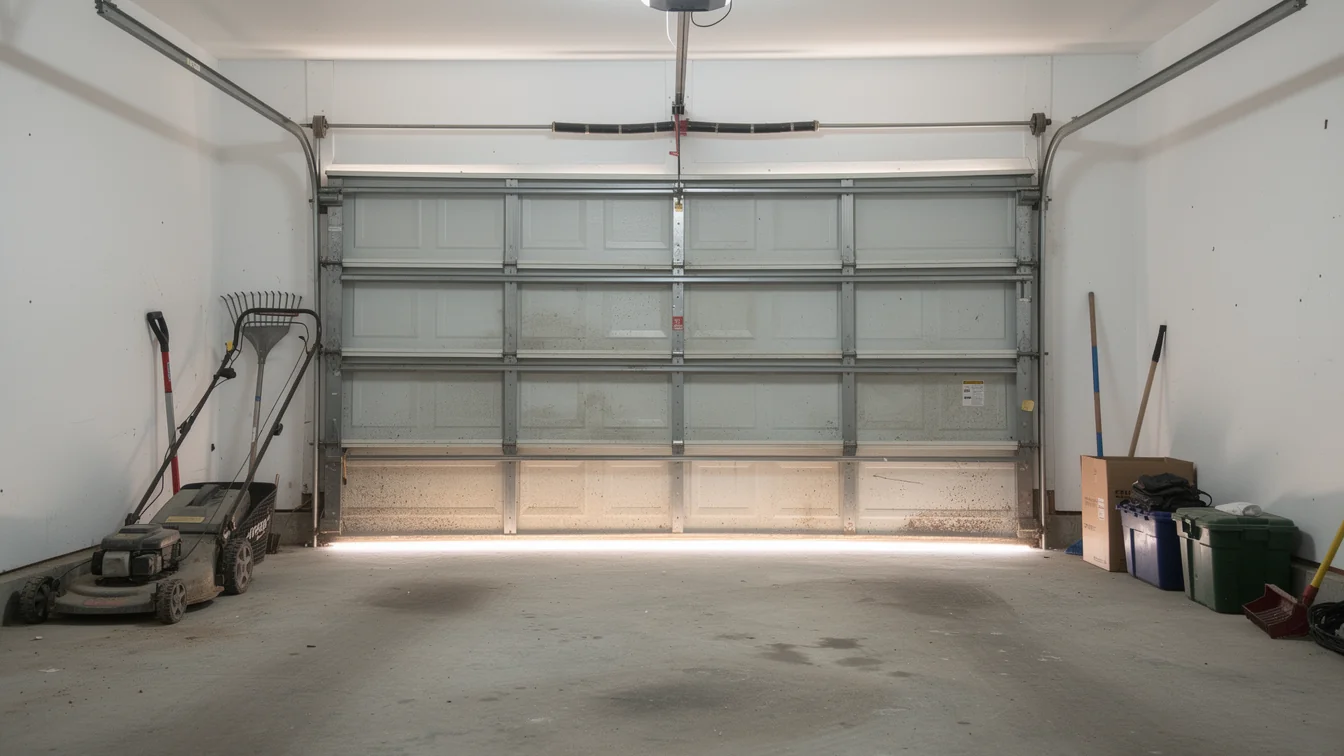
Start by looking at the bottom corner of each panel from inside the garage, with the door down. On a single-layer steel door from the 1980s-90s era, this is where you'll see the first signs of give: a slight outward bow, rust starting at the seam, or a corner that's visibly softer than the rest of the panel when you press on it.
Next, check the bottom seal. Pull it away from the panel. If it cracks or tears instead of flexing back, it's past its working life, and on an original door from that build period it's likely never been replaced.
Then watch the door move through one full cycle. A single-layer panel that's starting to bow will often show a faint wave as it travels, especially midway up the track, that you won't see when the door is sitting still.
Last, put a hand flat on the inside of the panel on a hot afternoon. If it's noticeably warmer than the air in the garage, that's the uninsulated steel doing exactly what it was built to do. None of this tells you whether to replace yet. It tells you whether what you're hearing is the door's original steel finally showing its age.
Frequently asked questions
How do I know if my garage door is original to the house?
If your house was built during the 1976-2014 run common across this area and the door has a plain single steel skin with no visible foam layer when you look at the edge, it's very likely original. A lot of builder-grade doors from the 1980s and 90s never got upgraded unless something broke.
Does the mild climate here mean I don't need to worry about seals?
Not quite. The occasional freeze nights we get aren't the main stress on a seal here. Heat and UV over a long season dry out rubber faster than people expect, and a seal that's already brittle is what finally cracks on the one cold night a year.
Is it worth adding insulation to an old single-layer door instead of replacing it?
Sometimes, if the panel itself is still straight and the hardware is sound. But if the steel is already bowed or dented at the corners, an insulation kit won't fix the structural issue underneath it, and you'd be spending money on a door that's near the end of its run anyway.
Related garage door services in Missouri City
More garage door guides
Book garage door service in Missouri City
Call now or request a quote - tell us what the door is doing and where you are.