
Missouri City, TX · Garage Door Service
Garage Door Spring Repair, Missouri City TX
Torsion spring repair for Missouri City homes built 1976-2014. We know why these springs fail here and what it takes to fix or replace them right.
- Repairs & new doors
- Springs & openers
- Serving 4 nearby communities
How to Book
Call and tell us what the door is doing - won't lift, dropped on one side, loud bang followed by the door going dead. That's usually enough for us to know whether it's a torsion spring, an extension spring, or something else wearing the same symptoms. We ask for the door's rough age or the year the house was built, because across this service area that one number tells us a lot about the hardware we'll find behind the panel.
We don't quote spring jobs sight unseen over the phone beyond a range, because spring size, wind unit count, and cable condition vary house to house even within the same subdivision. A tech comes out, measures the spring wire and coil, checks the drum and cable for wear, and gives you a firm number before any work starts.
One limitation worth saying up front: if your opener is also failing and the spring job uncovers a cracked drum or a bent shaft, that's a separate repair we'll flag rather than bundle in blind. We'd rather tell you two true numbers than one number that grows once the door's open.
Doing It Yourself
A torsion spring is under enough stored tension to break a wrist or worse, and winding bars sized wrong for the spring are one of the more common ways people get hurt on this job. We're not going to walk you through winding one here.
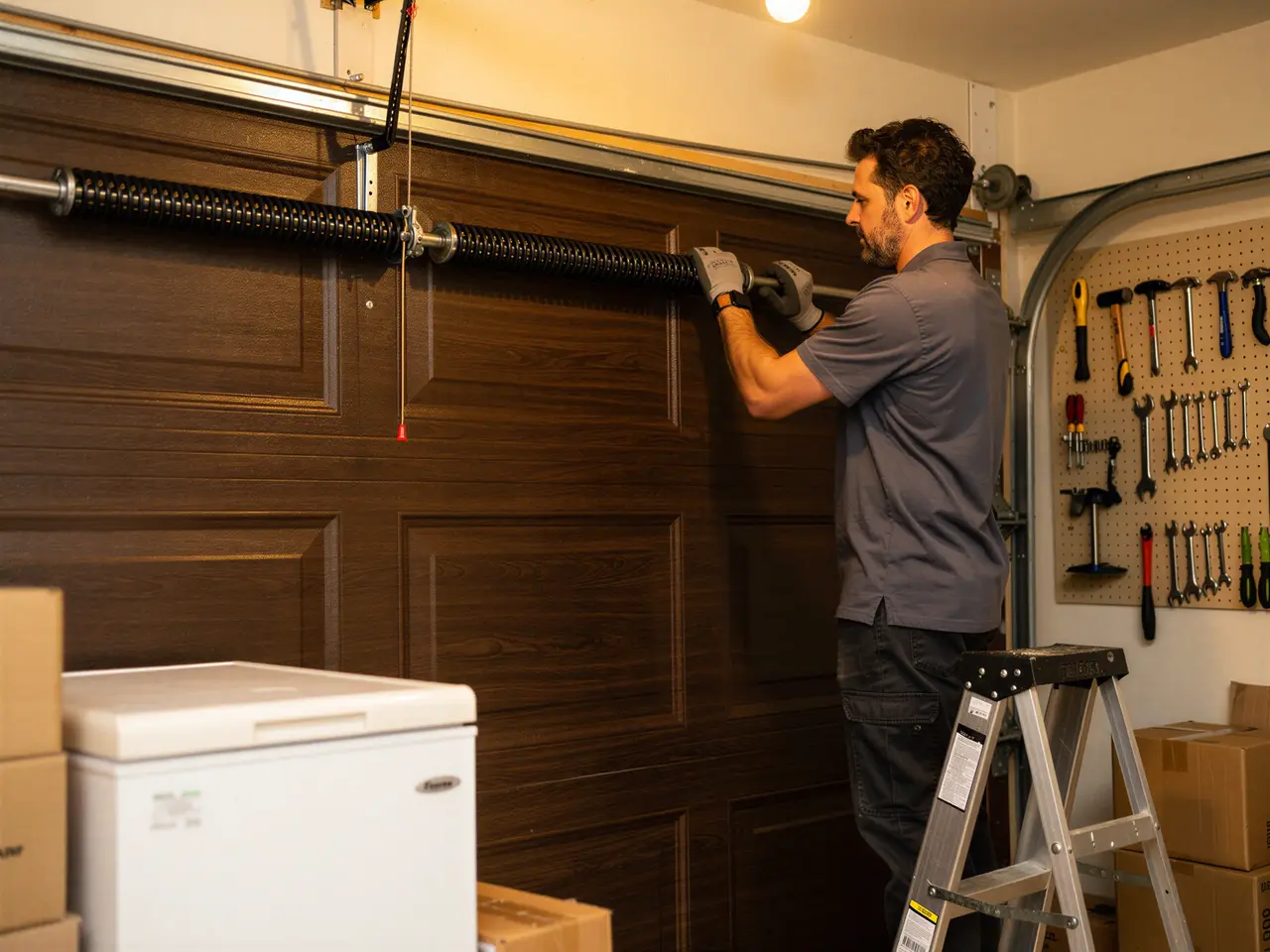
What you can safely check yourself: whether the door is a torsion-spring door (one spring, or two, on a shaft above the door) versus an older extension-spring setup (a spring stretched along each horizontal track). Photograph what you see and send it when you call - it saves a diagnostic trip.
You can also test the door's balance without touching the spring: disconnect the opener, lift the door by hand to waist height, and let go. A balanced door with a healthy spring stays put. One that drops means the spring's lost tension and is close to done. That's useful information for us and doesn't put you near the loaded hardware. Beyond that - leave the winding cones and the bar alone.
The Symptom
The door won't lift, or the opener strains and reverses, or you hear a loud crack from the garage and the door won't move at all. Sometimes it's quieter: the door closes unevenly, dropping faster on one side, or it feels heavier every month until one day it just stops.
Most of these calls across the service area trace back to a torsion spring that's reached the end of its wind count - the number of open-close cycles the steel can take before the coil fatigues and lets go, often without any warning crack at all. A smaller share are extension-spring failures on older setups, usually paired with a worn pulley or a cable that's frayed through.
If only one spring on a double-spring door has broken, the door can look like it's working - until the second spring gives out under double the load it was never built to carry alone. That's the call we get a week after the first one: same door, same symptom, worse timing.
Why It Happens Here
Housing across this service area mostly went up between 1976 and 2014, with the bulk of it - the 21 named communities we cover, from Quail Valley a mile northwest to Cinco Ranch eighteen miles out - built in the 1980s and 90s. That matters for springs more than most people expect: a torsion spring is rated in cycles, not years, and a door installed when a subdivision was built in the mid-80s has had three to four decades of daily cycling by now. A lot of that original hardware is simply past its rated life, and it's failing on schedule, not by bad luck.
Climate here is mild with only occasional freeze, so we don't see the hard freeze-thaw cracking that kills springs further north. What we do see is steady heat cycling - garages that run hot for long stretches - which dries out lubrication and speeds up metal fatigue on coils that are already near the end of their count.
With 61,077 owner-occupied houses across the service area, that's a large base of doors built in the same two-decade window, which is why spring failure is one of the most common calls we take, not an occasional one. For a household income median near $126,167 in this area, most owners choose a full spring replacement with upgraded hardware over a patch, since the labor to open the door is the same either way.
Frequently asked questions
How do I know if it's the spring and not the opener?
If the opener motor runs but the door barely moves, or moves then reverses, that's almost always a spring that's lost tension, not the motor itself. A dead opener with no sound at all is more likely an opener or electrical issue. Disconnecting the opener and lifting the door by hand tells you fast - a bad spring makes the door feel heavy or impossible to lift manually too.
Can one broken spring on a two-spring door wait a few days?
It can run, but the second spring is now carrying a load it wasn't built for, and it usually fails within days or weeks of the first. We'd rather replace both at once - mismatched spring age is one of the more common repeat calls we get.
Is my spring original to the house?
If your house was built in the 1980s or 90s, which covers most of the stock in this service area, it's very possible. Torsion springs are rated in cycles rather than years, so a thirty-plus-year-old spring has usually logged far more cycles than its rating allows, even without visible damage.
Do you repair extension springs too?
Yes. They're less common than torsion springs in the newer construction here but still show up on older setups. The failure mode's usually a stretched or snapped spring paired with a worn pulley, and we check both when we're out.
By Neighborhood
Spring Repair across the Missouri City area
We also handle spring repair in these Missouri City-area suburbs.
Book garage door service in Missouri City
Call now or request a quote - tell us what the door is doing and where you are.